

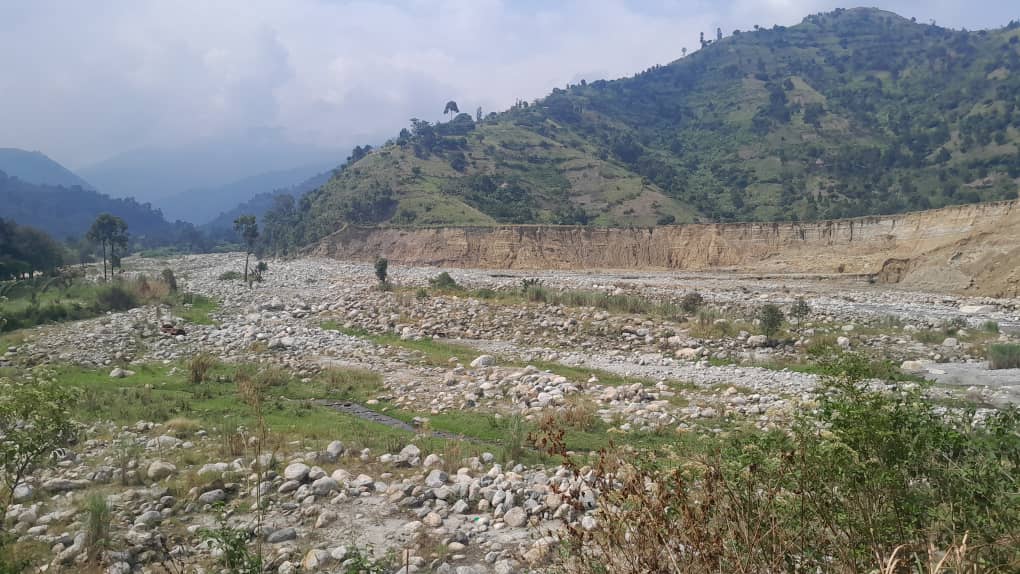
The government has unveiled a Shs 360 billion design for the second phase of River Nyamwamba’s de-silting project in Kasese, promising a lasting solution to recurrent floods that have devastated lives, property, and infrastructure for years.
Under the new plan, the government will de-silt the entire 19.6-kilometre stretch of River Nyamwamba, which flows from the Rwenzori Mountains through Kasese Municipality.
Officials say the project aims to provide sustainable protection for flood-prone communities that have long endured seasonal destruction.
Of the total Shs 360 billion required, only Shs 90 billion—about a quarter of the funding—is currently available. Despite this, officials and community leaders say the initiative represents renewed hope for thousands of residents living along the riverbanks.
River Nyamwamba is one of the most flood-prone rivers in western Uganda. Its recurrent overflows have displaced families, destroyed bridges and roads, and claimed lives across Kasese District for more than a decade.
The government launched the first phase of de-silting four years ago, focusing mainly on clearing sections of the river and constructing gabions.
However, experts and local leaders say that phase offered only temporary relief.
“Phase One was a good start, but it covered only a small section,” said Richard Bomera, Chairperson of the Nyamwamba Catchment Management Committee.
“The new design under Phase Two addresses the entire catchment, meaning all critical points will be worked on. This is the kind of intervention we have been waiting for.”
According to the new blueprint, Phase II will involve full de-silting of the 19.6-kilometre river channel, construction of gabions to prevent erosion, replacement of broken bridges, and procurement of modern machinery for continuous maintenance.
“We are hopeful this time the project will go a long way in minimizing flooding risks and supporting both social and economic recovery in Kasese,” Bomera added.
Flooding along River Nyamwamba has had a particularly harsh impact on women and children.
Expectant mothers often struggle to reach health facilities during rainy seasons, while schoolchildren risk their lives crossing swollen streams to attend classes.
“During heavy rains, we cannot cross to the hospital or market,” said Margaret Kasazi, a resident of Nyamwamba Division.
“Expectant mothers have suffered the most. We pray the government speeds up this project.”
Peter Mbunda, a resident of Kilembe Quarter, said the community lives in constant fear whenever rains begin. “Every rainy season, we live in fear,” he said.
“Our houses are destroyed, bridges collapse, and children can’t go to school. We just need a permanent solution.”
As residents await the start of Phase II, the unveiling of the new design has reignited optimism that the long-standing Nyamwamba flooding crisis could finally be resolved—restoring safety, livelihoods, and confidence in Kasese’s disaster recovery efforts.
